Corporate Christmas party branding works best when it helps guests understand the event and gives the celebration a coherent look. Start with the invitation, arrival experience and main focal point. You do not need a logo on every available surface.
The useful question is not “What else can we print?” It is “What does this asset do for the guest?”
At a glance
- Brand the invitation, arrival signs, one main focal point, the photo moment and practical table items.
- Skip logos on every surface and decorative text that hides key details.
- Use one event name and one colour direction everywhere.
- Keep one approved artwork register so every supplier works from the same files.
Start with one visual direction
Agree a short event name, a colour direction, the approved logo treatment and the tone of the message. Keep these in a simple reference sheet before suppliers begin design work.
Decide whether Christmas is the central theme or whether the event is a broader year-end celebration. That choice affects the invitation, décor and language. A clear direction reduces the need to redesign everything when a late stakeholder sees the artwork. If the format itself is still open, compare seven office Christmas party formats first.
1. The invitation should do the practical work
Make the date, venue, arrival time, dress guidance and response method easy to find. Keep important instructions as readable text rather than burying them inside a decorative image.
Use the same event name everywhere. If the invitation says “Summer Celebration” and the welcome screen says “Annual Gala”, guests should not have to wonder whether they are in the right room.
Confirm the details before exporting final files. A beautifully designed invitation with the wrong arrival time is still the wrong invitation.
2. Arrival signage should remove uncertainty
Plan the route from the entrance or parking area to the event. Identify where a welcome sign is useful and where a directional sign is more important.
Keep messages short enough to read while moving. Ask the venue about suitable sign positions and attachment methods before manufacturing anything.
Avoid printing names or guest information on public-facing boards without a clear reason and an approved approach to privacy.
3. Give the main room one strong focal point
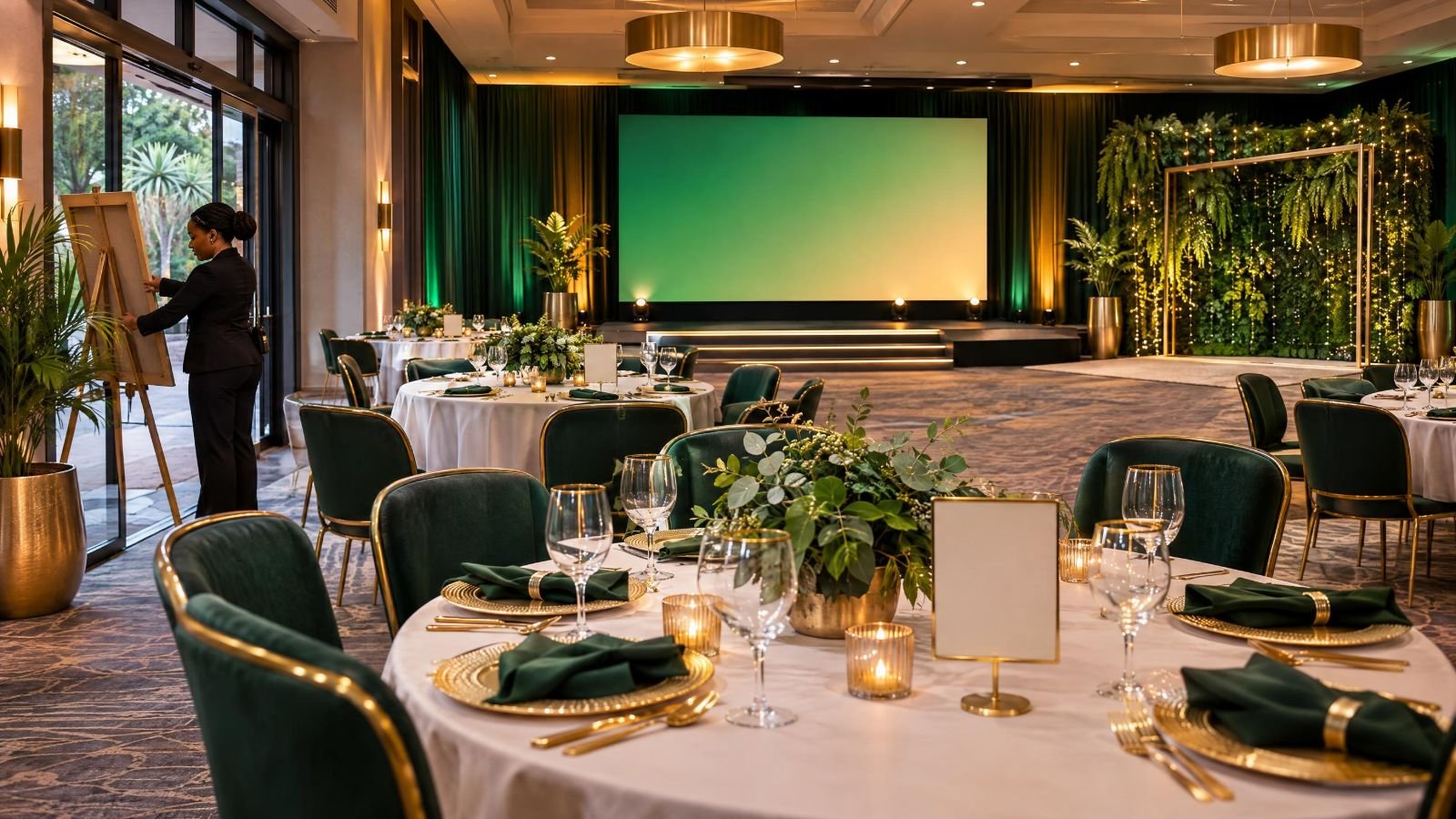
A stage backdrop, welcome screen or carefully designed photo area can establish the theme without competing with the rest of the room.
Ask the technical team for the actual screen dimensions and file requirements. Check how graphics look with the lighting and equipment that will be used. Leave room for speakers, furniture and people in photographs. If you are hiring in the screen and staging, ask the AV supplier, such as The Events Guys, for the exact specifications before design starts.
If an awards segment is planned, make names and award titles legible. The template should serve the person being recognised, not compete with them.
4. Plan the photo moment around people
A photo area needs more than a backdrop. Consider its location, lighting, queue space and how guests will receive their photographs. If you want edited photographs rather than phone snaps, book a corporate event photographer early; Event Photography SA, for example, books vetted photographers across Gauteng and promises an edited gallery within 24 hours.
Keep the message readable when people stand in front of it. Think about a group photograph as well as a close-up. Avoid making every photograph look like an advertisement when the purpose of the event is to thank staff.

5. Use table and service branding selectively
Menus, table numbers and food labels have a practical role. Make that information clear before adding decorative flourishes.
For bars or food stations, check wording with the supplier. Do not print ingredient, dietary or service claims from an unapproved draft. Keep any detailed guest requirements out of public-facing materials.
Reusable items can be worth considering where the design remains relevant beyond one date. Compare the actual production, storage and transport requirements instead of assuming reuse is automatically the simplest option.
The same thinking applies to branded gifts and table favours: choose something guests will keep. A corporate gifting studio such as Kugzulu can brand and package them, but year-end is a busy time for gifting suppliers, so brief early.
Keep an artwork and production register
Use one list with the following fields:
| Asset | Purpose | Required specification | Approver | Status |
|---|---|---|---|---|
| Invitation | Explain the event and response method | Confirm with publishing channel | Assign internally | Draft |
| Welcome sign | Reassure guests they have arrived | Confirm with fabricator and venue | Assign internally | Draft |
| Screen graphics | Welcome and programme support | Confirm with AV operator | Assign internally | Draft |
| Photo backdrop | Create a shared visual moment | Confirm dimensions and installation | Assign internally | Draft |
These rows are a planning template, not a supplier specification. Add quantities, deadlines and revision numbers as the brief develops.
Check the whole experience before signing off
Read every name and date. Check screen files with the operator. Confirm who installs each physical item, when it arrives and who removes it. Save one approved version so suppliers do not manufacture from different attachments. For the rest of the planning, work through our office Christmas party checklist.
For examples of branded event environments, browse B&W Productions’ published work. It is a useful starting point when you write your own brief.
Branding questions
Should we put the company logo on every item?
Not necessarily. Prioritise coherence and usefulness. One recognisable focal point can work better than many competing logos.
When should we brief a branding supplier?
As soon as the event direction and essential details are stable enough to quote. Ask the supplier for their real approval and production deadlines before announcing a delivery date.
Planning a corporate function?
Tell Event Planners your date, headcount and city, and we’ll get back to you.